
Home Contest Pinup girl Species Videos Tips Boats Gear Guides Recipes Contact Subscribe
Join our Forum Google for Fishermen Submit Article Store Advertise Site Map
Visit our sponsors
Proper hook sharpening
A properly sharpened hook will result in more landed fish. The point of a fish hook is expected to penetrate the fish's mouth with as little force as possible being used. In addition, the point should stay sharp over a period of time. A hook point that is too tapered will break off when bumped against the bottom, or a log, or anything that offers some resistance. A hook point that is sharpened too bluntly wont penetrate easily enough resulting in few catches.
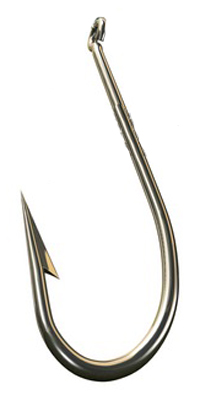
Sharpening a hook is easy once you have done it a few times. There's four basic things to remember when sharpening a fishing hook.
1) Start with the hook's shank parallel to the length of the file, or wet sanding stone. (I like a file for larger hooks and a stone for the smaller ones.)
2) The hook's point should meet the file or stones surface at a fairly flat angle of 5 to 15 degrees,
3) At this flat angle, scrape the hook's point along the file or stones surface so that the very tip of the hook's point is leading the way. Don't go back and forth on the file or stones surface. I've seen other pros demonstrate the opposite directional motion of having the hook's point trailing. You sharpen the hook with the point leading to avoid leaving burrs. Do not file a hook across the point, always in the direction of the hook shank.
4) Use the motion described in (3) all around the circumference of the hook's point.
To check if your hook is sharp draw the hook across your thumbnail at a 45-degree angle. If it sticks into your thumbnail instead of sliding across it’s sharp enough.
Visit our sponsors
Below are not our sponsors.