
Home Contest Pinup girl Species Videos Tips Boats Gear Guides Recipes Contact Subscribe
Join our Forum Google for Fishermen Submit Article Store Advertise Site Map
Visit our sponsors
The rainbow trout (Salmo gairdneri, Oncorhynchus mykiss), the most widely distributed member of the trout family, is one of the five top sport fishes in North America.
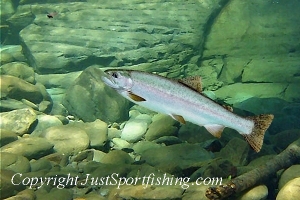 Originally a native of the Pacific
coast drainage system from Mexico to Alaska, it is now found through out North
America and many other countries as a result of stocking. Sea-run rainbows on
the Pacific coast are known as steelheads. A landlocked variety in the interior
of B.C. is called the Kamloops trout. The rainbow has an elongated body, with an
iridescent, reddish band running along each side from head to tail. Both the
color and size of this fish vary with the environment. In the sea-run type, the
back is dark blue, with sides and underparts silvery. In the non-migratory type,
the back is bluish to olive green shading to silvery green on the sides and
white over the belly. The color of the lateral stripe varies from light pink to
a vivid red or reddish purple and is most pronounced in mature fish, especially
breeding males. Sides, tail and dorsal fins are profusely dotted with small,
dark spots. Rainbow Trout are genetically closest to the Pacific salmon. The
Rainbow Trout has a very good sense of smell, if you compare it to the human,
the rainbow trout has a sense of smell 400 times more sensitive. They use this
strongly adapted sense to help identify prey, structure and spawning locations.
Originally a native of the Pacific
coast drainage system from Mexico to Alaska, it is now found through out North
America and many other countries as a result of stocking. Sea-run rainbows on
the Pacific coast are known as steelheads. A landlocked variety in the interior
of B.C. is called the Kamloops trout. The rainbow has an elongated body, with an
iridescent, reddish band running along each side from head to tail. Both the
color and size of this fish vary with the environment. In the sea-run type, the
back is dark blue, with sides and underparts silvery. In the non-migratory type,
the back is bluish to olive green shading to silvery green on the sides and
white over the belly. The color of the lateral stripe varies from light pink to
a vivid red or reddish purple and is most pronounced in mature fish, especially
breeding males. Sides, tail and dorsal fins are profusely dotted with small,
dark spots. Rainbow Trout are genetically closest to the Pacific salmon. The
Rainbow Trout has a very good sense of smell, if you compare it to the human,
the rainbow trout has a sense of smell 400 times more sensitive. They use this
strongly adapted sense to help identify prey, structure and spawning locations.
The rainbow trout begin to spawn when they reach about 15 inches in length. Quite often they are about three years old when they reach sexual maturity. The trout seek out shallow gravel bottoms or a clear river or stream as their primary spawning locations. The spawn generally occurs from early April through to the end of June, depending on the water temperature and post winter conditions. Some rainbow however, may spawn in the fall.
The rainbow trout is well adapted to both streams and lakes. While it prefers cold, clear, swift-flowing water, it can tolerate warm water. Its beauty, strength, endurance and spectacular leaps have endeared it to anglers. And it is a prize worth striving for, as its flesh, which varies in color from bright red to white, has an exceptionally fine taste.
Fishing for Rainbow Trout
 In
general, large rainbows are caught in large bodies of water and small ones in
streams and ponds. Stream-caught fish usually weigh under 1 lb., while fish from
the rivers and lakes weigh between 1 lb and 5 lbs. Rainbows that have migrated
to sea or a large inland lake such as one of the Great Lakes (steelheads), on
return may weigh 14 to 18 lbs, although most weigh between 7 and 9 lbs. The
present angling record is 43 lbs 10 oz. caught in Deinfenbaker lake, Canada on
6/5/2007. The rainbow trout is a very strong fish. It has an amazing
acceleration rate and can sustain a very high speed for a number of seconds. It
is not uncommon for a rainbow to un-spool a reel of fishing line within a minute
after hooking it.
In
general, large rainbows are caught in large bodies of water and small ones in
streams and ponds. Stream-caught fish usually weigh under 1 lb., while fish from
the rivers and lakes weigh between 1 lb and 5 lbs. Rainbows that have migrated
to sea or a large inland lake such as one of the Great Lakes (steelheads), on
return may weigh 14 to 18 lbs, although most weigh between 7 and 9 lbs. The
present angling record is 43 lbs 10 oz. caught in Deinfenbaker lake, Canada on
6/5/2007. The rainbow trout is a very strong fish. It has an amazing
acceleration rate and can sustain a very high speed for a number of seconds. It
is not uncommon for a rainbow to un-spool a reel of fishing line within a minute
after hooking it.
The fish frequent waters between 32F (0C) and 77F (25C), with the ideal temperature in lakes at about 64F (18C) degrees. They can also be found at a variety of depths depending on the oxygen levels in the lake. The rainbow trout has the ability to sense very small movements in the water. The fish can even sense the miniature movements of a fly or a water bug from a distance. Their diet consists mainly of Mayflies, Caddis flies, Stoneflies and their larvae, eggs, and other small fish including their own species.
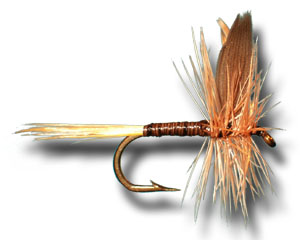
Fly fishing in rivers and streams can be productive working pools at the head with Caddis or Stonefly Nymphs of different colors. A 5/6 weight fly rod and reel is suitable for most rivers and streams. When fishing for Rainbow Trout in lakes a spinning rod and reel with 6-8 lb line rigged with a small spinner and worm or egg spinner like the Wedding band has produced results. Trolling a fly rod with streamer flies such as the Woolly Bugger and Mickey Finn , Muddler Minnow and Black nose Dace have can also be productive.
Visit our sponsors
Below are not our sponsors.