|
|

|
Home Game Fish Fishing Knots Tackle Tips Videos Pictures Tips Rods & Reels Boats Cook your Catch Articles About Contact |
|
Donate to JustSportfishing.com and help to build the largest fishing information site on the web. Even a dollar or two will keep us building this free site.
|
Lake
Trout World
Record
~ 72 Lbs Caught at Great Bear Lake, N.W.T. on Aug. 19, 1995 by angler
Lloyd E. Bull Scientific
name
~ Salvelinus Namaycush Other
names
~ Laker, Mackinaw, Gray
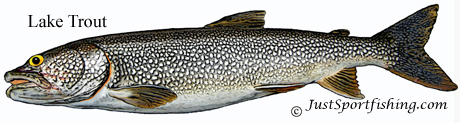
Trout, Togue, Lake Charr, Great Lakes trout Identification ~ The Lake Trout has a moderately elongated body with a tail that is forked. Of the Charr family the Lake trout has the tail that is the most forked. The scales are small and the coloration can vary but generally they are grayish to brownish along the back and sides with a white belly. They have white or nearly white spots that extend to the dorsal. Like other Charr the Lake trout has a white or whitish leading edge to all its lower fins. In the Lake trouts mouth there are several rows of teeth.
Size
~ There are Lake trout caught that weigh from 20 to 50 pounds and Lake
trout reaching over 80 pounds have been reported. Most anglers will find
that their catches of Lake trout will weigh the average of
4 to 10 pounds. Habitat
~ The Lake trout prefers water temperatures of around 50º F. The lake
trout is usually found in the deep waters of still large, deep lakes and
reservoirs, inhabiting waters of 60 to 300 feet. Lake trout prefer
cruising near the bottom in search of food. Least tolerant of salt water
of all the chars. Lake trout have been introduced into many other parts
of the world, mainly into Europe but also into South America and certain
parts of Asia. Approximately 25 % of the world's lake trout lakes are
found in the province of Ontario. Feeding
Habits
~ The Lake trouts
diet includes insect larvae, small crustaceans, clams, snails, and
leeches. The Lake trout also feeds on many species of fish depending on
the location of the lake they inhabit. These fish include whitefish,
stickleback, grayling, suckers, cisco, alewives, sculpin, smelt and even
young lake trout.
|