|
|

|
Home Game Fish Fishing Knots Tackle Tips Videos Pictures Tips Rods & Reels Boats Cook your Catch Articles About Contact |
|
Donate to JustSportfishing.com and help to build the largest fishing information site on the web. Even a dollar or two will keep us building this free site.
|
Brown
Trout World
Record
~ 40 Lbs 4 oz. Caught at
Little Red River, AR on May 9, 1992 by angler Rip Collins Scientific
name
~ Salmo Trutta Other
names
~ German Brown Trout, Brownie, Loch Leven Trout, Saibling, European
Brown Trout, Von Behr Trout, and English Trout Identification
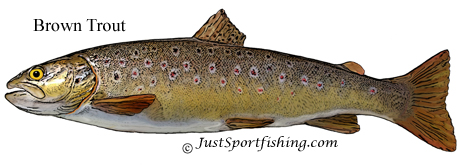
~ A Brown trout's body can be olive green, brown, or golden brown in
overall tone. The belly is white or yellowish. Large, dark spots are
outlined with pale halos on the sides, the back and dorsal fin, with
reddish-orange or yellow spots scattered on the sides. The head and the
fins along the back can have spots. The sea run Brown Trout are more
silvery and the spots less visible Size ~ Normal size for a river or stream Brown trout is 9 to 16 inches and 1 to 2 pounds. Brown trout that reside in large lakes or are sea run can exceed 10 pounds.
Habitat
~ The Brown Trout is a wary and elusive fish that looks for cover more
than any other trout. They will take cover under over hanging banks,
logs, big rocks, deep pools, and overhangs of vegetation. The sea run
Brown Trout can live up to 9 years at sea. The brown trout is native to
Europe and western Asia and was introduced into North America in 1883.
It can be found in most waters in Canada with the exception of Prince
Edward Island and Manitoba. The essential requirements for brown trout
to survive are clear, well-oxygenated cool water, and temperatures of 54
F to 68 F. They can survive in waters up to 75 F but do best in rivers
and lakes below 68 F This is usually found in mountain or upland
streams, away from occupied, cultivated or overgrazed lands, but may
also be in lakes or farm dams in which the catchments is well managed. Feeding
Habits
~ Generally feeds on aquatic and terrestrial insects, crabs, frogs and
small fish if they are available. Sea run Brown Trout have a diet of
mostly smaller fish, whereas Brown Trout in streams and rivers tend to
have a diet mostly made up of insects.
|