|
|

|
Home Game Fish Fishing Knots Tackle Tips Videos Pictures Tips Rods & Reels Boats Cook your Catch Articles About Contact |
|
Donate to JustSportfishing.com and help to build the largest fishing information site on the web. Even a dollar or two will keep us building this free site. |
Blue
Marlin World
Record
~ Pacific ~ 1376 Lbs Caught at Kaaiwi Point, Kona, HI on May 31, 1982 by
angler Jay W. deBeaubien Atlantic
~ 1402 Lbs 2 oz. Caught at Vitoria, Brazil Feb. 29, 1992 by angler Paulo
R.A. Amorim Scientific
name
~ Pacific Makaira Mazara Atlantic ~ Makaira Nigricans Other
names
~ Pacific Blue Marlin, Atlantic Blue Marlin, Billfish, Cuban Black
Marlin, Marlin Identification
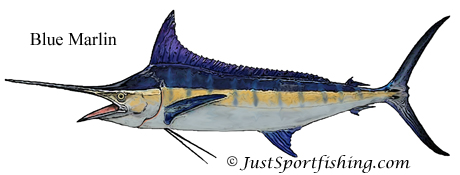
~ The back of the Blue Marlin is dark blue and the flanks and the belly
are silvery white. There may be light blue or lavender vertical stripes
on the sides. These usually fade away soon after death.The blue marlin
is the largest billfish. The upper jaw forms a large bill. The body is
cylindrical from anal fin forward. Two dorsal fins are present; the
first dorsal fin is high and slopes steeply posteriorly, while the
second is small.The Blue Marlin is one of the foremost game fish in the
world. It has exceptional strength and power, a very aggressive fighter
with long hard runs. Size
~ The blue marlin can reach a length of 14 feet and a weight of one ton
. Females are generally much larger than males. IGFA lists separate
records for Atlantic and Pacific blue marlin. Habitat
~ The blue marlin is found primarily in the temperate and tropical
regions of the Ocean. The blue marlin occurs mostly from about 44° N to
30°S. Occurring offshore in blue oceanic waters, the blue marlin
prefers to stay in the warm waters near the surface, above the
thermoline. They follow the seasonal water temperature changes, being
closely tied to these warm waters. They are found in ocean waters great
distances from the continents as well as coastal regions near deep
waters. Feeding
Habits
~ The blue marlin is capable of consuming prey of relatively large
proportions. Primarily near-surface pelagic fishes such as mackerels,
tunas, and dolphin fishes are preyed upon by the blue marlin. Squids,
and the occasional deep sea fish have been noted in the stomachs of blue
marlin.
|