|
|

|
Home Game Fish Fishing Knots Tackle Tips Videos Pictures Tips Rods & Reels Boats Cook your Catch Articles About Contact |
|
Donate to JustSportfishing.com and help to build the largest fishing information site on the web. Even a dollar or two will keep us building this free site. |
Bigeye
Tuna World
Record
~ 435 Lbs caught in Cabo Blanco, Peru
on Apr. 17, 1957 by fisherman Dr. Russell Lee Scientific name ~ Thunnus Obesus Other
names
~ Bigeyed Tuna, Bigeye Tunny, Ahi Identification
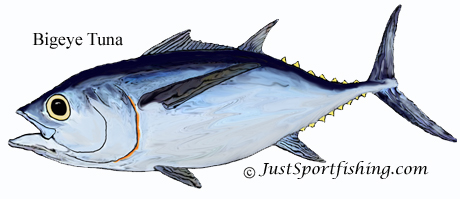
~ Bigeye tuna is dark metallic blue on the back and upper sides with
white lower sides and belly. The first dorsal fin is deep yellow, the
second dorsal and anal find are brownish or yellowish with narrow black
edges, and the finlets are bright yellow with broad black edges. Their
bodies are stocky and robust, and adults' eyes are large. Size
~ The Bigeye caught by sport
fishermen typically measure from 18 inches to 70 inches. Habitat
~ Bigeye tuna is found in the Atlantic, Pacific, and Indian oceans in
warmer temperature waters between 55 and 84º F. In the western
Atlantic, they can be found from Nova Scotia to Argentina, including the
Caribbean and the Gulf of Mexico. Bigeye tuna are a pelagic species -
they are found from the surface to about 800 feet deep. Bigeye tuna are
highly migratory. Juvenile and small adult Bigeye tuna form schools
mostly mixed with other tunas such as yellowfin and skipjack, especially
in warm waters. These schools are often associated with drifting objects Feeding
Habits
~ Bigeye tuna feed at night and during the day on fishes, squid, and
crustaceans found from the surface to a depth of 500 feet. They favor
shrimp, mackerel, and other small tuna.
|